
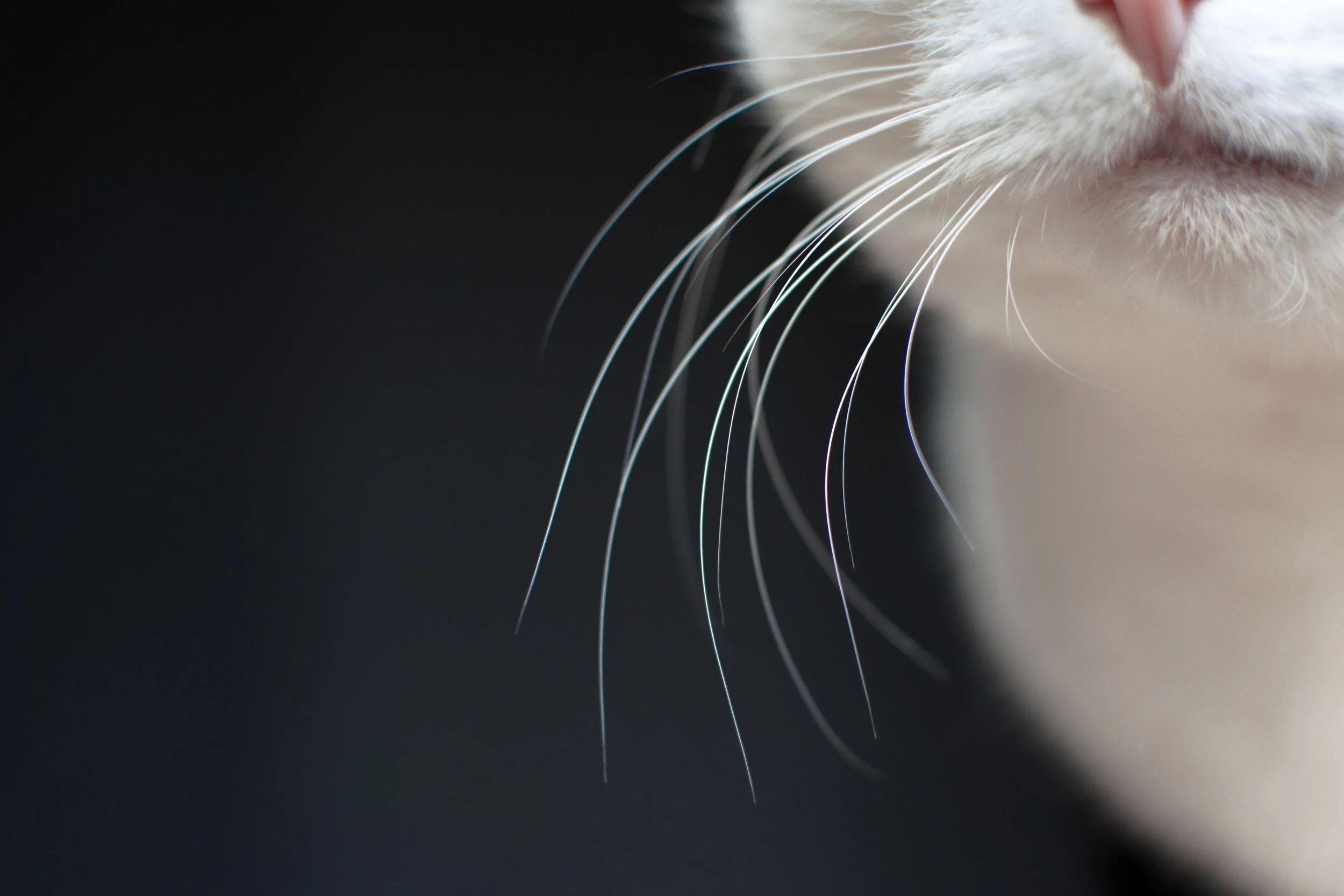
Cats seem to love narrow openings, cardboard boxes, or pretty much any new object. They investigate their world with an appetite for learning, using the tools they’ve been given. While they may not be equipped to ask questions and have things explained to them, they are equipped with far better sensory receptors than the average human. This gives them a very literal assessment of their surroundings. Whiskers are one of these tools.
Known scientifically as the vibrissae, whiskers are much more than ordinary hairs. They're specialized structures that help cats interpret their surroundings, detect movement, and navigate the world with remarkable precision. In fact, your cat's whiskers are so sensitive that they can detect subtle changes in the air around them!
They're Definitely Not Just Hairs
Although whiskers look similar to ordinary fur, they're quite different. They're thicker, more deeply embedded in the skin, and connected to highly sensitive nerve endings and blood-filled structures at their roots.
These connections allow whiskers to transmit information about even the slightest physical movements. When a whisker brushes against an object, or when air currents move around it, sensory receptors send information to the cat's brain.
Think of them as tiny biological antennae, constantly gathering information about the environment.
And while facial whiskers are the most recognizable, cats actually have specialized whiskers in several places on their bodies. These include above their eyes, along their cheeks, beneath their chin, and on the backs of their front legs.
Each set serves a slightly different purpose, but they all help cats build a better understanding of what's happening around them.
Helping Cats Navigate Their Surroundings
Cats are naturally curious creatures, and their whiskers help them explore their surroundings safely.
One of their most useful functions is detecting nearby objects and surroundings. Because whiskers are incredibly sensitive to touch and movement, they help cats identify obstacles and navigate tight spaces, investigate unfamiliar objects, or move around in the dark.
You may have heard that cats use their whiskers to determine whether they can fit through an opening. While whiskers certainly help cats assess nearby spaces, they aren't a perfect measuring tape. Their length can provide useful sensory information, but cats also rely on their eyesight, body awareness, and experience when deciding whether they can squeeze through an opening.
Whiskers Help Cats Hunt
A cat's whiskers aren't just useful for avoiding obstacles. They're also important hunting tools.
Cats are predators by nature, and their whiskers help them detect movement and interact with prey. The whiskers around their muzzle and cheeks can provide information about where an animal is located, even when it's difficult to see clearly. This becomes especially important when they catch something.
A cat's eyesight is not particularly well suited to focusing on objects immediately in front of its nose. Its whiskers help compensate by providing additional sensory information about the position and movement of nearby objects.
The whiskers on the backs of a cat's front legs are also thought to help with sensing and monitoring prey during close contact.
It's another example of how cats are equipped with specialized tools that make them remarkably effective hunters.
Whatever You Do, Never Trim Your Cat's Whiskers!
This is perhaps the most important thing for cat owners to understand. Because whiskers are sensory structures, trimming them can interfere with a cat's ability to gather information about its surroundings. Removing their length doesn't necessarily cause permanent damage to the underlying sensory system, but it does reduce the whiskers' ability to perform. While whiskers are sometimes lost naturally, and they do grow back, it is by no means a reason for anyone to trim a cat’s whiskers.