
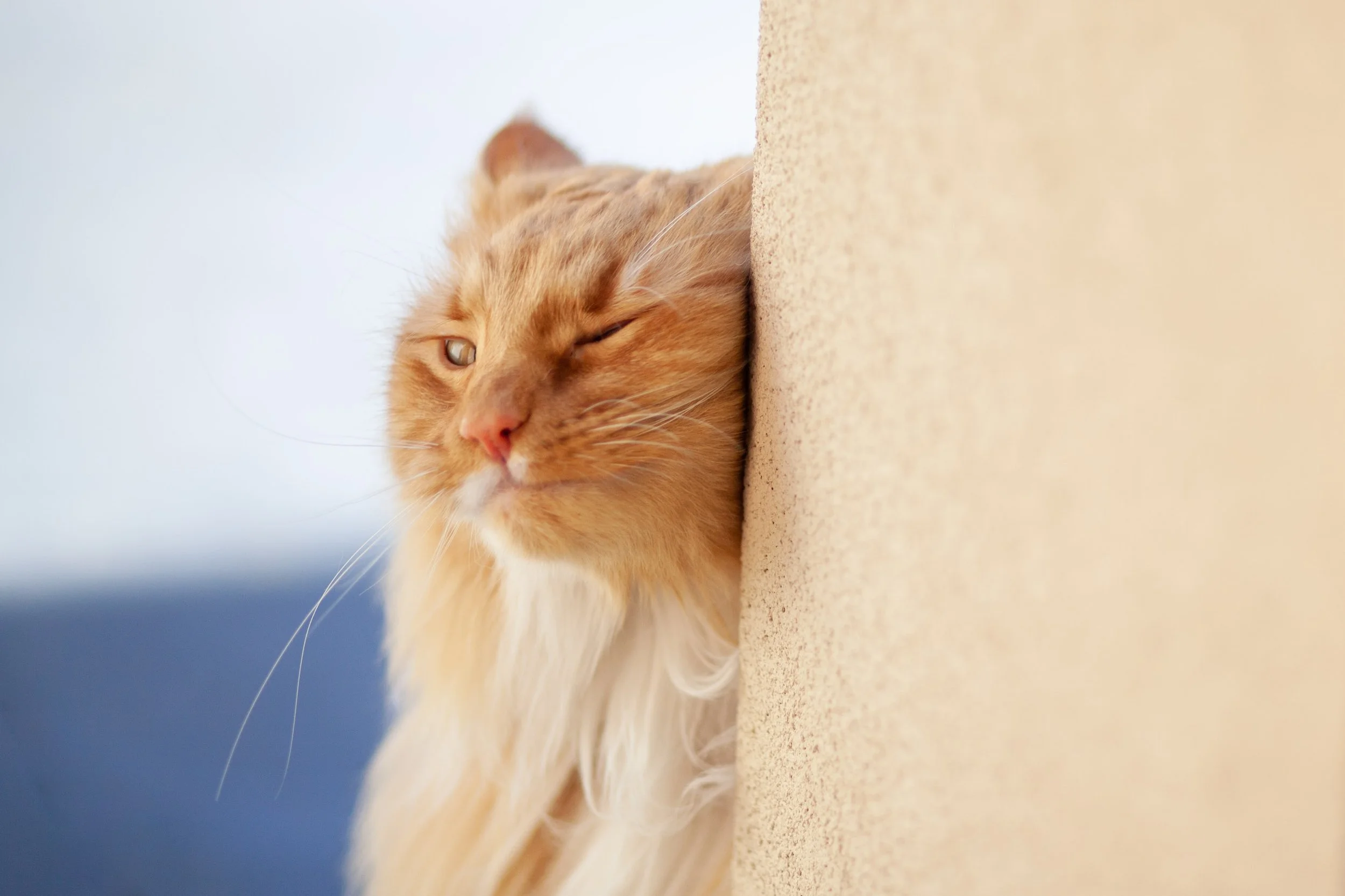
Cat people know all about face rubs, and if you are new to cat ownership, you have nothing to worry about! Nothing is wrong with your cat – in fact, it’s proof they are quite normal. All cats love rubbing their cheeks on things, and there are some pretty good reasons for it.
Your Cat Has Scent Glands on Their Face
Cats have scent glands around several parts of their face, including their cheeks, chin and forehead. When they rub these areas against an object or person, they can leave behind some of their unique scent. To your cat (and others), this scent is information.
It helps communicate that something is familiar and belongs within their environment. In a sense, your cat is creating a little olfactory map of their world one rub at a time.
This is one reason you may notice your cat repeatedly rubbing against the same furniture, doorframes or other objects. They aren't necessarily trying to leave a visible mark. Their message is written in a language that we simply can't smell.
It Can Be a Sign of Affection
When your cat rubs their face against you, they may be marking you as their human, but another message may be involved as well.
Cats often use rubbing as a friendly social behaviour. A cat may rub against your legs when you come home, press their head against your hand when you reach down to pet them, or brush their cheek against you while sitting beside you.
This behaviour can be a way of saying, “You are familiar. You are safe. You are part of my social world.”
So, while your cat may not be giving you a traditional hug, that little face rub can be a pretty meaningful feline greeting.
What About Head Bumps?
There is a closely related behaviour that cat lovers often call a “head bump” or “head bunting.” This happens when a cat deliberately presses their forehead or head against you.
It can be an especially friendly interaction and is generally considered a positive social behaviour. If your cat gives you a gentle head bump, you can usually take it as an invitation to interact, although, as always, let your cat's body language tell you whether they want more attention.
A relaxed body, upright or gently moving tail and soft eyes are generally good signs. If your cat suddenly becomes tense, pulls away, flattens their ears or starts flicking their tail sharply, it may be time to give them some space.
Why Do Cats Rub Against Furniture?
Your home is filled with unfamiliar smells from people, other animals, cleaning products, food, outdoors and countless other sources. A cat's scent-marking behaviour helps make their surroundings feel familiar.
Rubbing against objects can therefore be part of maintaining their territory and creating a sense of security.
It may also explain why some cats immediately investigate and rub against new furniture, boxes or objects brought into the house. Anything new has introduced a new smell into their environment, and your cat wants to know exactly what it is.
It would be easy to assume that all rubbing is simply about claiming territory, but feline behaviour is rarely that straightforward.
Face rubbing can serve several purposes, including communication, social bonding, familiarity and scent exchange. Cats may also rub against one another as part of friendly social interactions.
And sometimes, of course, your cat may simply enjoy the sensation. That cheek scratch against the corner of your computer monitor might feel pretty good!
Should You Stop Your Cat From Rubbing?
Usually, there is no reason to discourage normal face rubbing. It's a natural behaviour and an important part of how cats interact with their environment.
In fact, providing appropriate objects for your cat to rub against can be another form of environmental enrichment. Cat trees, scratching posts, beds and other safe furniture can all become part of your cat's familiar territory.
There is one important exception: a sudden change in rubbing behaviour can sometimes indicate a problem.
If your cat begins rubbing their face excessively, develops redness or irritation, loses fur, scratches frequently, or seems uncomfortable, it's worth speaking with your veterinarian. Excessive rubbing can sometimes be associated with skin irritation, allergies, parasites or other medical issues.